Choice before intent
A feature-rich zero state can force users to interpret the product before the product understands their goal.
STRATEGIC PRODUCT CASE STUDY · CROSS-BORDER FINTECH

A growth-oriented FTUX redesign focused on increasing D7 Activation Rate and reducing Time-to-First-Value for a user’s first international transfer.
Portfolio strategy exercise based on public product flows. Funnel baselines and projected impacts are illustrative, not production metrics.
CONTEXT & PROBLEM FRAMING
High registration volume does not create value if users fail to complete the first cross-border transaction. Every user acquired but not activated dilutes paid acquisition efficiency, increases effective CAC and weakens the path to repeat behavior and LTV.
The first successful transfer — not account creation — is the moment where the product proves its core value.
A feature-rich zero state can force users to interpret the product before the product understands their goal.
Full KYC before the user sees concrete transfer value can make regulation feel like an entry barrier rather than a justified step.
Quote, recipient, funding and verification steps can feel like separate tasks instead of one coherent mission.
QUANTITATIVE DIAGNOSIS & BENCHMARK
Illustrative diagnostic funnel for the strategy exercise. Replace with Mixpanel/Amplitude production data before using as an internal business case.
| Stage | Illustrative baseline | Drop-off | Strategic read |
|---|---|---|---|
| Sign-up complete | 100% | — | Acquisition is working. |
| KYC complete | 72% | −28% | Regulatory friction appears before value. |
| First quote | 48% | −24pp | Zero state is not moving enough users into intent. |
| Payment initiated | 32% | −16pp | Funding/payment adds operational friction. |
| First transfer complete | 21% | −11pp | Only 1 in 5 acquired users reaches core value. |
Account creation + identity verification precede full use; transfer flow includes destination, quote, beneficiary and payment/funding.
Transfer intent is explicit early; fees and arrival time are shown before completion, with identity verification required when needed.
Rate and total cost are surfaced early and payment options are tightly connected to the transfer task.
Transfers live inside a broader financial super-app, with live fees/rates shown before sending and multiple transfer methods.
REDESIGNED FIRST-TRANSFER FLOW
The redesigned flow connects quote, recipient, verification, funding and confirmation as one continuous mission — with progressive disclosure and clear reassurance at every step.
THE PROPOSED EXPERIENCE
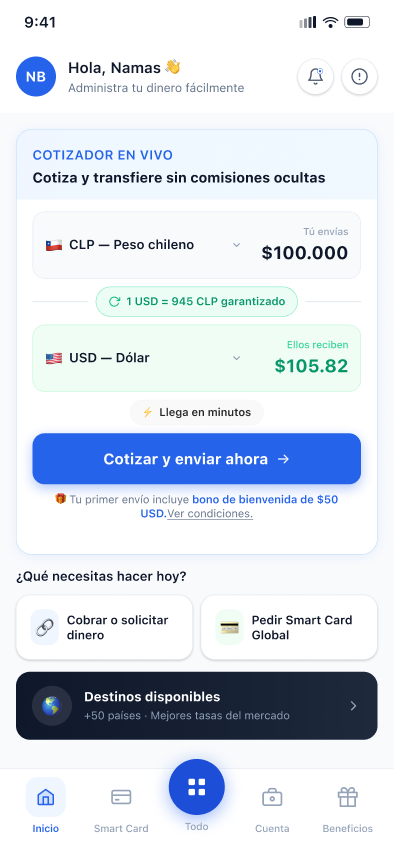
The home foregrounds the live quote so users can understand the exchange outcome before committing to the process.
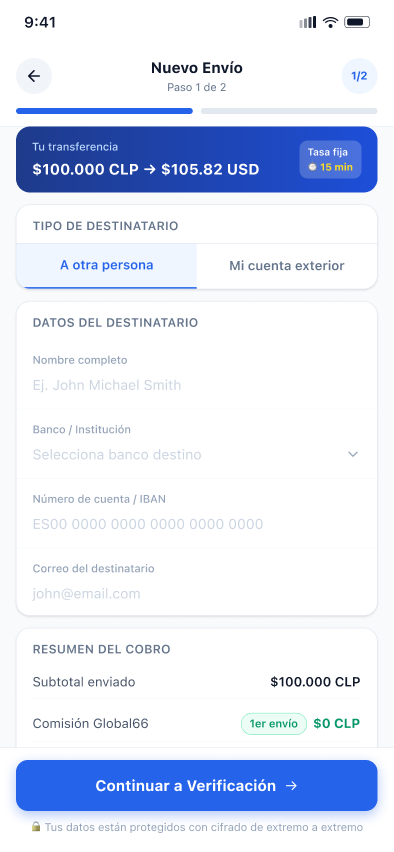
Recipient information is grouped into one focused task with the exchange context kept visible.
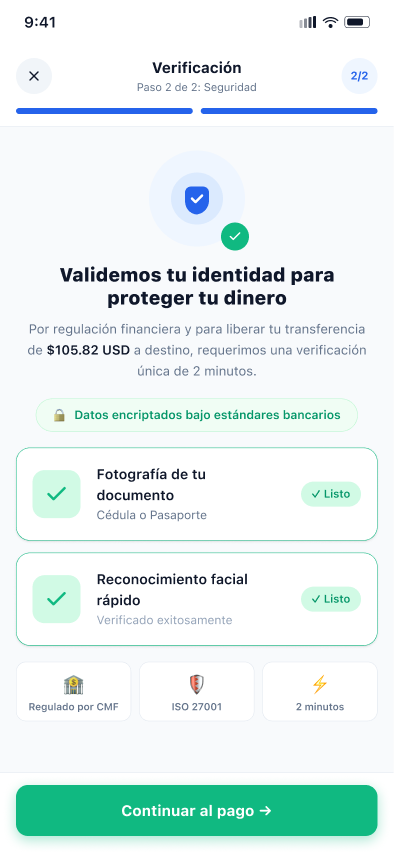
KYC is framed as the security step required to release the transfer, with effort, trust and completion status made explicit.
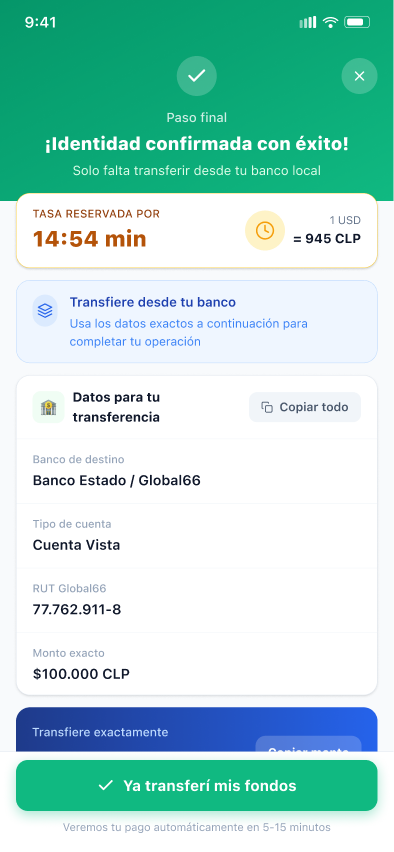
Bank-transfer instructions consolidate all required data and preserve the reserved rate while the user completes payment.
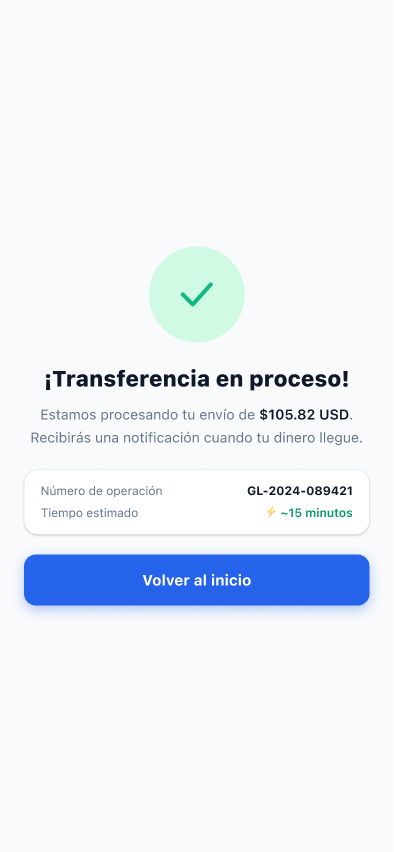
The final state confirms the transfer is being processed, shows the operation number and gives a clear time expectation.
UX STRATEGY · 4 PILLARS
Replace a generic home with task-oriented entry points: “Send money abroad”, “Receive money”, “Convert currency”. Reduce Hick’s Law cost by prioritizing the first high-value mission.
Let users explore the quote and understand value first; request identity verification at the point it becomes necessary to execute the transfer.
Make “You send / They receive / Fee / Arrival” the visual core. Explain regulatory and payment steps in contextual language, not institutional terminology.
Persist quote context, reduce repeated recipient data, expose payment constraints before the final step and support recovery when funding fails.
EXPERIMENTATION & BUSINESS METRICS
| Hypothesis | Control | Test | Primary KPI |
|---|---|---|---|
| Intent-first entry increases transfer initiation. | Current home | Mission-based zero state | Quote start rate |
| Showing value before KYC increases completion. | Early KYC | Quote → JIT KYC | KYC-to-transfer conversion |
| Transparent total cost reduces payment abandonment. | Standard breakdown | You send / they receive / fee / ETA | Payment completion |
| Better failure recovery preserves intent. | Generic payment error | Contextual recovery + saved quote | Recovered transfers |
Same acquisition spend generates more activated users.
Illustrative target from 21% to ~27–30%.
Fewer non-value steps before the first transfer.
First successful transfer becomes the leading indicator for repeat usage.
Expected impact ranges are directional hypotheses for prioritization. They require validation against real cohort economics, CAC, repeat-transfer rate and LTV.
PRODUCT TAKEAWAY
The strategic shift is simple: stop optimizing account creation in isolation and design the entire FTUX around reaching the first successful transfer with confidence, transparency and minimum avoidable friction.
← Back to selected work